Elden Ring is a once-in-a-lifetime experience
reader settings
tier lists are available at the end of the post. Two of them, indeed.
welp, yes, the title is a little clickbaity. no, i am not taking it back. 
“once-in-a-lifetime” is the kind of phrase people use when they are either 14 years old or about to oversell something. unfortunately for my dignity, I mean it.
of course Elden Ring is still far from perfect. Defend it however you like, the fact is that it is so guilty of:
- weak late game content (well this is a well-known problem with From games)
- weird quest design: most of the time you are just running around until you bump into someone that actually matters. Then you either fight them, talk to them, or talk to them and fight them

- too many dogsh*t NPC fights. Seriously, what the hell were they thinking
- many bosses make you feel like you are getting murdered by the brightest flashbang in the Lands Between while looking upon a fricking Disneyland fireworks show

and yet, in spite of all that, Elden Ring became the first game to surpass Skyrim in my heart.
that is not a light statement for me. I have spent an absurd amount of time in Skyrim, and I still go back to it every few months for emotional support.  I also love Oblivion, ARK, BOTW, and RDR2. As you can already see from the listed names, I love offline single-player games, especially fantasy ones. Open worlds are my thing. Wandering is my thing. Choosing an alternative path and asking, “wait, what is over there?” is very much my thing.
so when I say Elden Ring is a once-in-a-lifetime experience, I do not just mean that it is one of the best games I have ever played. I mean it did something I honestly did not think another game could do anymore. It made exploration feel important again. It made the journey matter more than the ending.
and somehow it did that while meeting me in two completely different stages of my life.
the right game at the wrong time
when Elden Ring came out in 2022, I was in my first internship. Right after that, I started working on my undergrad thesis. So even though I was excited for the game, I did not really have the time to live inside it the way a game like this demands.
i played until I beated Radahn, and then dropped it.
to be clear, I did not drop it because I thought it was bad. Even back then, I could already tell the game was special. But Elden Ring is not the kind of game you rush to the ending. It asks for attention. It asks for patience. It asks for enough room in your brain to keep thinking about the why, the how, and the what (will coming).
and in 2022, I simply did not have that luxurious room.
the second time a charm
I came back to the game in mid 2024, mostly because of the DLC.
the funny part is that my life had not become calmer. If anything, it had become worse for a game this big (FYI: it took me 120h for the base game, and another 40 for the DLC  ). By then I was working full time as an RnD Lead, and later in the same year I was working two jobs at the same time.
so logically, this should have been the playthrough where Elden Ring bounced off me again.
instead, it completely swallowed me.
that is one of the big reasons this game feels so personal to me. It met me once when I was too busy to really give myself to it, then met me again when I was arguably even busier, and somehow only became more powerful. The deeper I went, the better it got. That almost never happens. Usually games peak early, then settle into routine. Elden Ring kept unfolding.
Limgrave is an insane first impression
if I had to point to the first real “damn” moment, it would be right after stepping out of the hero grave into Limgrave.
you leave the opening area, see the Erdtree, meet Varré , and it is CINEMA.
then you get Torrent and realize there is basically no real world boundary in the way most games quietly enforce one. That’s it – from the first moment, you are already on your own, because this is your story.
that feeling is hard to describe if you have not played it, but it is the kind of design decision that changes the entire emotional temperature of a game. Limgrave is beautiful, but more importantly, it is inviting. It makes you want to move slowly, to look around. It makes curiosity feel rewarded instead of inefficient.
that is probably the best gift Elden Ring gave me: the encouragement to explore, while also encouraging me to go slow. In a lot of modern open-world games, exploration is technically available but spiritually fake. You are still being funneled. You are still cleaning icons off a map. You are still being trained to think like a manager of tasks instead of a traveler. (yes, I’m talking about you, Ubisoft).
Stormveil and Caelid: beauty and devastation
Stormveil Castle is one of the clearest examples of why Elden Ring is  GOATED. It is massive, memorable, and beautiful. It echoes the great glory of itself in the past. A lot of open-world games can do scale. Fewer can do scale while still making a place feel carefully authored. Stormveil is not just big for the sake of being big. It feels layered, dangerous, and rich with intention. Simply peak level design.
then there is Caelid, which hits in the exact opposite way.
Caelid is scary. Devastating. Sick. It does not just look hostile. It feels morally damaged, like the land itself has been injured past recovery. And that matters, because it shows you that Elden Ring’s world is not only vast; it has emotional range. Some places are beautiful. Some places are majestic. Some places are horrifying. Caelid is one of the moments where the game stops being merely impressive and starts becoming oppressive in a way that I mean as praise.
well, all is good except the NPC invasion gatekeeping the area. Geez. 
Elden Ring is not just about gods and war
(this is your SPOILER ALERT  )
)
one of the moments that really changed how I looked at Elden Ring was Irina’s death.
before that, it is easy to look at the game and think in the biggest possible terms: gods, demigods, war, betrayal, dynasties, apocalypse, very dramatic Game of Thrones energy, all of that. But Irina and Edgar cut through that immediately. Seeing her dead, then seeing her father broken by grief, crying, cursing, and collapsing into despair, was one of the first times the game made me feel that this world was not only about cosmic struggle. It was also about ordinary suffering.
that was the moment where Elden Ring became, for me, not just a story about power, but a story about life, the cycle of life, despair, cruelty, and chaos.
that matters because scale alone does not make a world meaningful. Lore alone does not make a world meaningful. A world becomes meaningful when its grand conflicts are reflected in human pain. Irina’s death is small compared to everything else happening in the Lands Between, and that is exactly why it hits. It reminds you that even in a world of gods and monsters, grief is still grief.
chaos, the Hornsent, and the circle of despair
talking on lore, we have to talk about Marika’s story.
the shaman and Hornsent story hit me especially hard. It gave so much of the larger tragedy a sharper shape: why Marika became a god, why she would want to take away death, why she sent her son into an unhonored war to massacre the Hornsent. It connected history, cruelty, divinity, and fear in a way that made the whole setting feel less like a pile of cool mythology and more like an actual wounded civilization trying to rationalize its own violence.
and Shaman Village deserves a special mention here, because the atmosphere of that place is unreal. The music  alone gave me chills. It is one of those rare moments where a game is not just telling you something through lore text or exposition, but through mood, through its soulful music, and through the feeling that something sacred and broken is still lingering in the air.
the Chaos ending  deepened that even further.
at first, chaos in Elden Ring feels weirdly out of place. It can seem like one random faction, one strange questline, one disturbing village, one more flavor of apocalypse in a world already full of them. But the deeper I got into the story, the more it started making horrible sense. To me, it represents something deeply human: the desire to escape order, to escape despair, to tear down a reality that feels fundamentally unbearable and be born again under the same origin.
that is what I mean when I say Elden Ring is more than just a good fantasy game. It has layers of human desire and suffering under all the spectacle. Even its most extreme ideas are still recognizably human.
Malenia and the final recognition
I’m not VaatiVidya, so let’s stop talking lore (love the guy btw, definitely go check him out).
I beated Elden Ring who knows how many times. There are many variants for each playthrough, but there is one thing that has never changed:
I always fight Malenia last
… no matter which format I play. Even when I did daily randomizer runs (similar to LilAggy’s weekly randomizer speedrun), even when I did the French Challenge, even when I did SL1 or no-hit runs.
that is a ritual for me now.
so why does it matter?
you can finish the game. You can do every quest. You can become a god (or a lord, if you will). You can clean up the map, understand the lore, and technically do everything the game asks of you. But if you tell your friend about beating the game, one question always come up: “Yes, but did you beat Malenia?”
what beating Malenia means to me is simple. It is the triumph of victory. It is the celebration walk. It is the fight for honor.
and one thing I have always loved about FromSoftware games is that the most difficult, most challenging, and often most satisfying fights are almost always optional. The game does not need to force you into them for them to matter. In some ways that makes them matter more. You choose them. You go there because you want the test.
funny enough, Malenia is not even the boss I got stuck on the longest the first time around. Mohg (the real one) gave me more trouble on my first playthrough, and Promised Consort Radahn was a sh*tshow its own form of suffering. But Malenia is different. She is not just another hard boss, she is a symbol of recognition, the final climax, and beating her is the tale that the fans told each other. Sound like copium? Because yes, it is lol! 
“you are exaggerating, the game has so many flaws”
I know.
yeah yeah, because I am me, I cannot write this without also saying the game has some pretty annoying problems.
in fact, they made me so mad  that I can write an entire blog “my problems with Elden Ring” if I wanted to. But I won’t, to save myself from the allegation, and to save you guys from the rant.
do I really mean once-in-a-lifetime?
absolutely! 
what I mean is not that no game will ever be better.
what I mean is that very few games arrive in your life twice and still manage to change shape both times. Very few games make exploration feel sacred again. Very few games can hold wonder, dread, grief, philosophy, and triumph in the same world without collapsing under their own ambition.
and very few games can take the place of Skyrim in the heart of someone who thought that seat was already permanently taken.
that is what Elden Ring did for me.
so yes, the title is dramatic.
but I still think it is true.
Elden Ring is a once-in-a-lifetime experience, not because it is perfect, but because it made me care about the journey again in a way I honestly thought games had already spent years teaching me to forget.
“hey, what about…”
shh, I know, I know. I keep my promise.
and here are,
*drumroll* 
your precious tier lists:
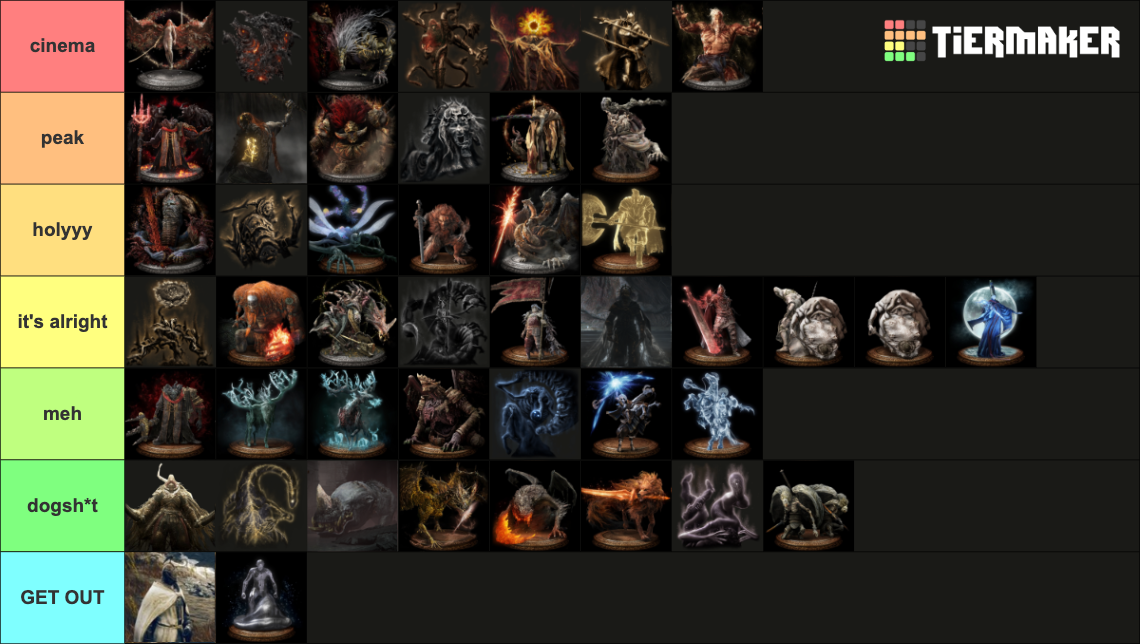
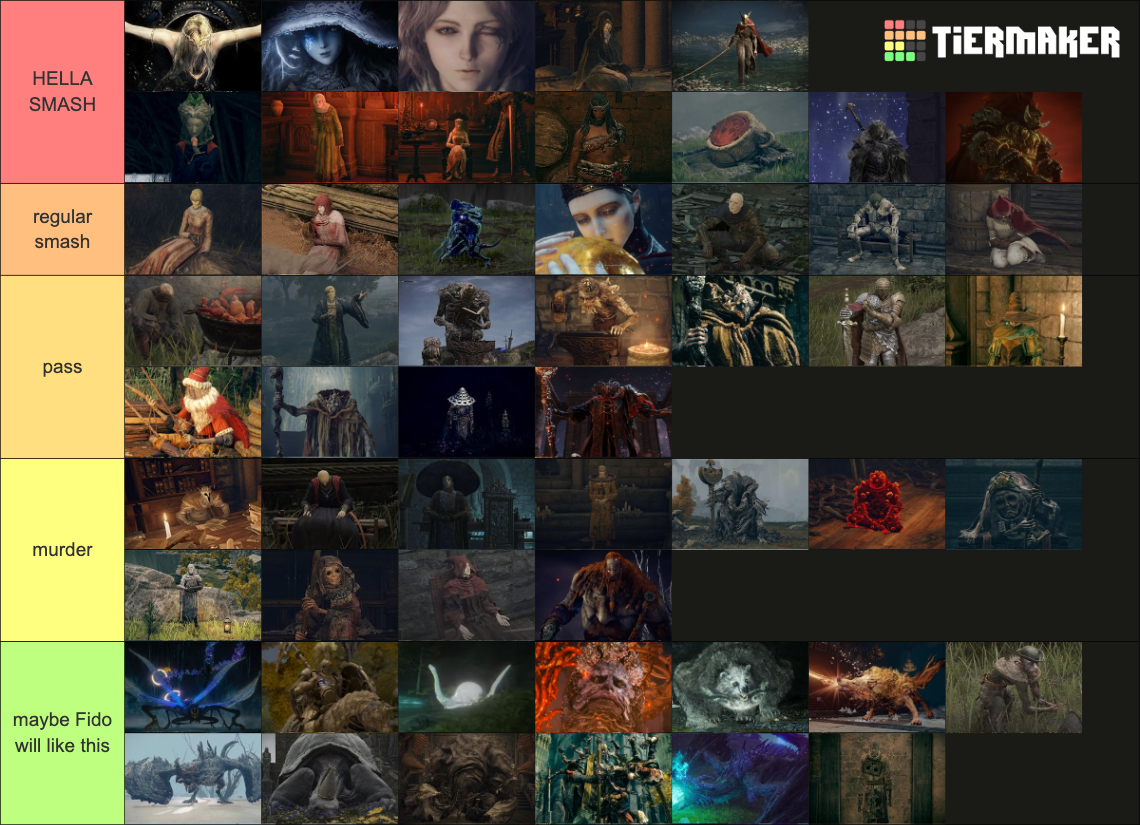
no, no, I’m not gonna elaborate on these 